
Everyone asks us about ingredients. Almost nobody asks about temperature — and it turns out that's the question worth asking as the weather turns.
Here's something that happens every year around now. The mornings get cool, and the person who ordered a fresh green juice every day in July suddenly doesn't want it. Nothing about their nutrition needs changed. Their body's relationship to cold changed.
We've spent a lot of time talking about what goes into a cup at JuiceVibes. We've never really talked about the temperature of what's in it — and that's a gap, because it genuinely affects how you feel after you drink it.
What Cold Actually Does Well
Cold, raw, and unheated is where enzymes and heat-sensitive vitamins survive. Vitamin C starts degrading with heat. So do folate and several B vitamins. When you drink a fresh juice or a smoothie cold, you're getting those nutrients in close to the form the plant made them.
Cold also has a practical advantage that matters more than people think: it's fast and easy to drink. A juice takes two minutes. That's the real logic behind a morning juice — not some absorption trick, just the fact that you'll actually get several servings of produce into your day before 9am.
REACH FOR COLD WHEN
- You want vitamin C and folate intact
- You need something fast and portable
- You've just worked out and your core temperature is already up
- You want a lot of produce in a form you'll actually finish quickly.
What Warm Does That Cold Can't
This is the part that surprises people. Heat destroys some nutrients — but it unlocks others, and not by a small margin. Carotenoids like beta-carotene sit locked inside tough plant cell walls in a crystalline form your gut mostly can't get at. Heat breaks those walls down.
In one Cambridge study, beta-carotene absorption from carrots went from roughly 11% raw to about 75% cooked — a more than six-fold increase. Cornell researchers found cooked tomatoes lost 10–29% of their vitamin C but gained dramatically in absorbable lycopene.
There's a catch worth knowing: carotenoids are fat-soluble, so they need fat in the same meal to actually absorb. A study that cooked tomatoes with and without olive oil found the no-oil group got essentially no increase in blood lycopene. Cooking unlocks the nutrient; fat is what carries it in. Both have to be there.
Beyond the chemistry, warm food simply satisfies differently. A soup feels settling in a way a cold drink doesn't, even when the drink has more grams of vegetables in it — and that feeling is what determines whether you're still eating this way in November.
And there's the part that isn't strictly nutritional but matters anyway: people finish warm food in cold weather. The most nutrient-dense thing in the world does nothing for you if it sits in your fridge because it felt unappealing.
REACH FOR WARM WHEN:
- It's cold out and you want to actually finish it
- You want maximum beta-carotene and lycopene
- You want a meal that satisfies rather than a boost
- You're eating later in the day.
Pumpkin Is the Perfect Example
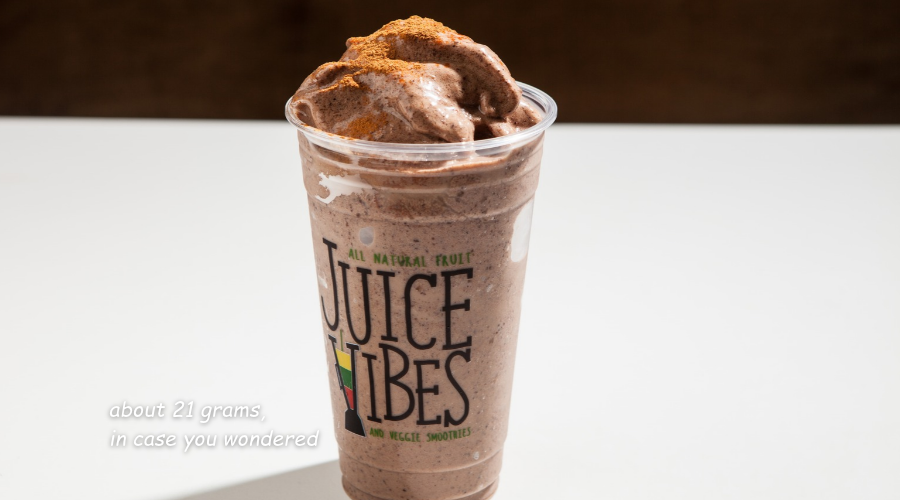
Our September feature makes this concrete, and honestly we didn't build it this way on purpose — we just noticed it holds up. The Pumpkin Pie Superfood Smoothie starts with real pumpkin puree, which is pumpkin that's already been cooked down. That's the cell-wall problem solved before it reaches the blender. Then it gets almond butter, flax, and hemp — which is exactly the fat those carotenoids need to absorb.
It's not a compromise between warm and cold. It's the cooked-nutrient advantage in a cold cup. Same logic in the Pumpkin Spice Bites — real pumpkin plus almond butter, pecans, chia, and flax carrying it, with dates and oats instead of refined sugar.
The Soups Are Back!
Two right now: Sweet Potato Quinoa — sweet potatoes, tri-colored ancient quinoa, red onion, red pepper, fire-roasted tomatoes, spices. And Vegetable Medley — kale, potatoes, celery, carrots, peas, onion, garlic, herbs.
Both are the warm side of this argument in a bowl: cooked sweet potato and carrot for beta-carotene, fire-roasted tomato for lycopene. Available by the pint or the quart.
Why September Is the Month People Actually Reset
January gets the credit, but September is when it really happens. School starts. Schedules firm up. Summer's looseness ends and people want structure again — and unlike January, you're not fighting winter to get it. There's still daylight. There's still momentum.
That's what makes this a good moment for a cleanse, and it's also why which cleanse matters more than people think.
Juice, Eat & Repeat — the warm-and-cold cleanse
Four juices plus a soup, salad, or frozen smoothie. Everything above is the reason this is the one we'd point you toward as the weather turns.
The juices give you the raw side — vitamin C and folate intact. Then you get a warm soup: cooked vegetables with their carotenoids unlocked, plus real satiety. In September, an all-cold cleanse is genuinely harder to finish. Pairing juices with a warm soup is what makes it sustainable past day two, and a cleanse you finish beats a cleanse you abandon.
We recommend a minimum of three days. Prefer all juice? The Luxury Cleanse is all juices, with superfood add-ins available.
So What Should You Actually Do?
Stop picking a side. The honest answer is that a body in September wants both, and the simplest version of that is: cold in the morning, warm in the afternoon.
Juice or a smoothie early, when you want produce fast and don't want to think about it. Something warm later, when you want a meal that actually settles. That's not a wellness trend — it's just paying attention to the season instead of running your July routine in October.
One more thing — we're open Saturdays now
You asked, and it's happening. Saturday hours are 10:00am–2:00pm, on top of Monday through Friday 8:00am–3:00pm. Which means the weekend reset is a lot easier to actually start on a weekend.
And keep an eye out for our fall juices as the produce shifts — new seasonal options are landing on the menu this month.